Competitive benchmarking to boost social media growth

Written by Annette Chacko
Published on December 3, 2025
Reading time 13 minutes

Table of Contents
Pop quiz: How does your social stack up against your closest competitors? Seems straightforward, but how much of your team’s knowledge is based on assumptions vs. data-driven insights?
Measuring success on social media is tricky. Should you be happy about those 100 retweets? Is a 2.4% engagement rate on Instagram cause for concern or celebration?
And that’s where competitive intelligence and competitive analysis come in. Competitive analysis gathers and analyzes information about competitors’ strategies, products, market positions, and performance. And in order to understand how your company stacks up against competitors, you can conduct competitive benchmarking.
Smart benchmarking starts with understanding which metrics drive real business impact. Focus on performance indicators that directly connect to your revenue goals and customer acquisition objectives.
What is competitive benchmarking?
Competitive benchmarking is the systematic process of measuring your company’s performance, processes and strategy against direct competitors and industry leaders. This data-driven approach establishes realistic performance benchmarks, reveals competitive gaps and uncovers strategic opportunities to accelerate your social media growth.
Social data helps improve your content strategy and drives competitive positioning. Smart marketers use competitive benchmarking to transform raw performance metrics into actionable insights that directly impact business growth.
Rather than second-guess whether a campaign or piece of content performed well, look at your benchmark and get a data-driven answer as to how it compares to similar efforts by competitors.
Difference between competitive benchmarking & competitive analysis
Competitive analysis and competitive benchmarking serve different strategic purposes, though they’re often confused.
Here’s the key distinction:
- Competitive analysis paints the bigger picture of your market landscape, revealing who does what and how across all business areas
- Competitive benchmarking zooms in on specific performance metrics, comparing your results directly against competitors to identify precise improvement opportunities
Both methods support brands in staying relevant in their industries. Each involves analyzing your competition to find strategic opportunities to improve or discover new market opportunities.
Competitive benchmarking takes your performance data and lines it up side by side with competitors. The goal is to see who takes the lead in specific areas and understand exactly how much you need to improve.
Why competitive benchmarking matters for social media
Competitive benchmarking transforms social media from a cost center into a growth driver. It provides the context leadership needs to see social’s true business impact.
Here’s what benchmarking delivers:
- Executive buy-in: Data-backed performance stories that secure budget and resources
- Strategic clarity: Precise identification of competitive advantages and improvement areas
- Faster optimization: Skip the guesswork and implement proven tactics from industry leaders
- Market positioning: Understand exactly where you stand and where you’re headed
Ultimately, it’s about making smarter, faster decisions that accelerate your brand’s impact on social media.
How to use competitive benchmarking
Benchmarking isn’t a one-size-fits-all kind of exercise. You need to use different lenses to see how your social campaigns stack up to others in your industry. Here are three types of competitive benchmarking to use:
1. Process benchmarking
Process benchmarking involves analyzing and comparing your company’s processes against your competitors. For example, how quickly do your competitors respond to comments, messages and mentions? Are your competitors ignoring negative reviews or customer complaints, or do they address them head-on?
If the information is publicly available, also check how your competitors find and vet influencers, and which analytics tools they use. Ideally, you want to identify opportunities to improve your response times and provide better customer service through social than your competitors while making your processes more efficient.
Let’s compare the jewelry brands Mejuri and Hey Harper as an example.
Mejuri regularly responds to most of the comments they receive from customers. The brand also keeps an eye on customer feedback and passes it on to their product team.

Hey Harper, on the other hand, isn’t as responsive to customer comments, which is a gap they can address to better meet consumer expectations in the space.

They increase engagement by acknowledging customer comments and questions and increase loyalty by showing they listen to their customers.
Competitive insights such as these guide you on how to structure your process, understand customer needs and preferences and of course, level up your social strategy.
2. Strategic benchmarking
Your social presence is a piece of the larger marketing strategy. Strategic social media benchmarking lets you compare your brand’s goal-setting, content strategies and other tactics with others in the market.
Here’s what you should focus on:
- Brand positioning: Check how your competitors position their brands on social media. Their tone of voice, visual branding and messaging are good places to start.
- Content marketing: Take a look at your competitors’ content marketing strategy. Note the types of content they create, the topics they cover and their distribution channels.
- Influencer marketing: Analyze the influencer marketing campaigns your competitors are running. Check who they work with and how they’re promoting it.
To see this in action, let’s look at budget airlines Ryanair and easyJet.
Ryanair’s social presence is all about humor. They take a lighthearted approach toward issues such as customer complaints and even consistently use a plane with a face in most of their videos to make them more fun and engaging.

Ryanair’s brand positioning is all about self-awareness. The video below garnered over 15 million views and 1.4 million likes, is based on the same sentiment.

The consistency and humor build engagement and brand awareness while supporting Ryanair’s standout performance against other budget airlines.
easyJet, on the other hand, takes a more serious approach to its social presence. Its content focuses on showcasing its crew and providing travel advice.

For example, in the video below, they provide supportive advice on how flight attendants support nervous flyers.

Ryanair is stronger on TikTok, with 2.7 million followers compared to easyJet’s 380k (at the time of writing).
A satirical approach makes the brand’s content shareable, but it’s missing opportunities to build trust with its customers.
On the other hand, easyJet needs to create more buzzworthy content if it wants to increase engagement and followers on TikTok.
This is an example of how competitive benchmarking supports your strategy optimization by identifying content opportunities and the platforms you should invest in.
3. Performance benchmarking
Performance benchmarking is all about measuring and comparing how well your social media efforts are performing compared to your competitors. Track key metrics, analyze data and identify areas for improvement.
Look at how many followers you have, how much engagement (likes, comments) your posts receive and how many people click on the links you share. Then compare these numbers to your competitors’ social media performance to see how you equate.
For example, if you’re comparing Mercedes and BMW’s X (formerly Twitter) accounts, Mercedes has more followers and posts than BMW. Looking deeper at their performance, such as average likes and retweets across posts and each account’s engagement rates, will support identifying gaps and opportunities for BMW to increase their following and customer loyalty on the platform.


This type of data analysis gives you an objective view of how your performance is faring against your competitors. Use this information to adjust your strategy and targeting efforts for better performance. Wondering how to find this data? Competitive monitoring is a great place to start.
How to identify your social media competitors
Before you measure, you need to know who you’re up against. Your competitors on social aren’t always who you think they are.
Your goal is to build a list of brands that are all fighting for your audience’s attention. Start with your direct competitors, which are the ones who sell similar products or services.
Then, expand to your indirect and aspirational competitors. Indirect competitors solve the same problem as you but with a different solution. Aspirational competitors are the brands you admire for their standout social presence, even if they’re in a different industry.
Look at who your audience follows and engages with. Analyze relevant hashtags and keywords to see which brands dominate those conversations. This process reveals the true competitive landscape and ensures your benchmarking efforts are focused on the rivals that matter most.
Competitive benchmarking metrics and tactics for social media
Track these eight critical metrics to build comprehensive competitive benchmarks:
1. Content performance
First things first: Marketers need to know what’s considered top-performing content in their space.
When you create consistent posts that explode in “likes” and shares, it’s a clear signal that you’re giving your audience what they want. Similarly, you should know what your competitors are posting that’s scoring them the same sort of love.
The good news? These numbers don’t have to be a secret thanks to competitive analysis tools. For example, with BuzzSumo you see the most popular content in your industry broken down by keyword. You can also see how well it’s performed across social media.
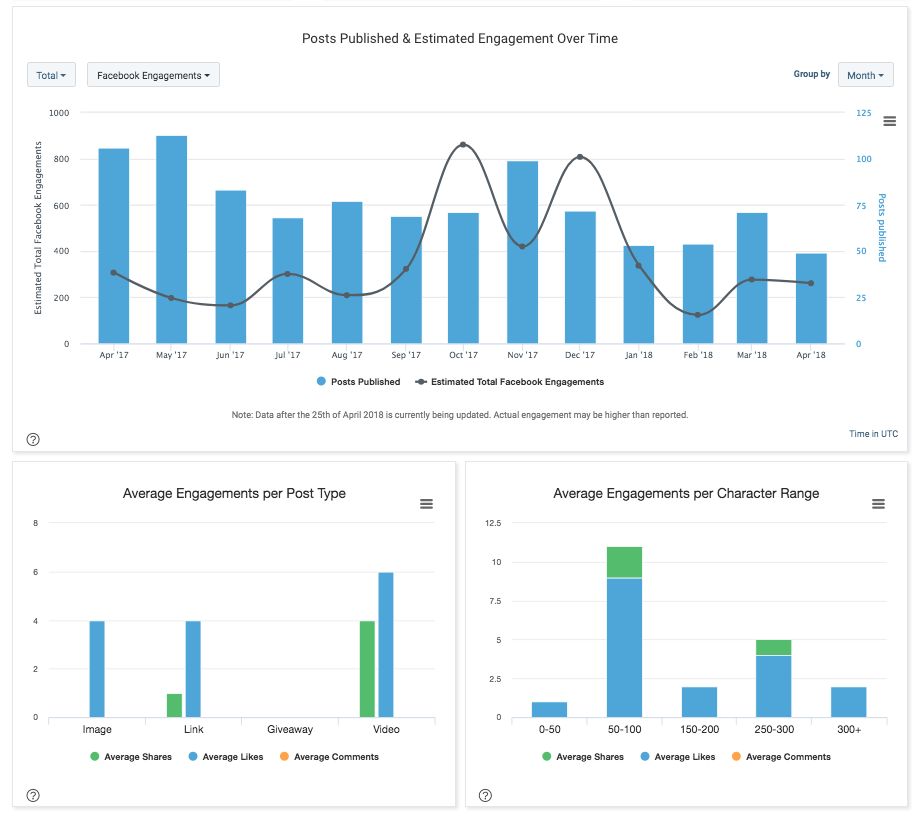
But more importantly, you need to start by zeroing in on which pieces of content are working for you.
For example, analytics such as engagement reports in Sprout Social provide an in-depth breakdown on which of your pieces score the most traction. Analyzing impressions, engagements and clicks gives brands have actionable insights on what they should be posting on a day-to-day basis.

By weeding out underperforming posts and content, you’ll consistently fine-tune your post performance over time. Identifying those posts that are consistently reliable, middle-of-the-pack performers serve as your benchmark of where your brand’s social content needs to be.
2. Timing and frequency
Timing is a critical competitive benchmark as brands try to maximize the number of eyeballs they get on any given post.
Data from our 2026 report on the best times to post shows that optimal posting times vary from platform to platform. Use these benchmarks as a starting point, then refine based on your own audience data.
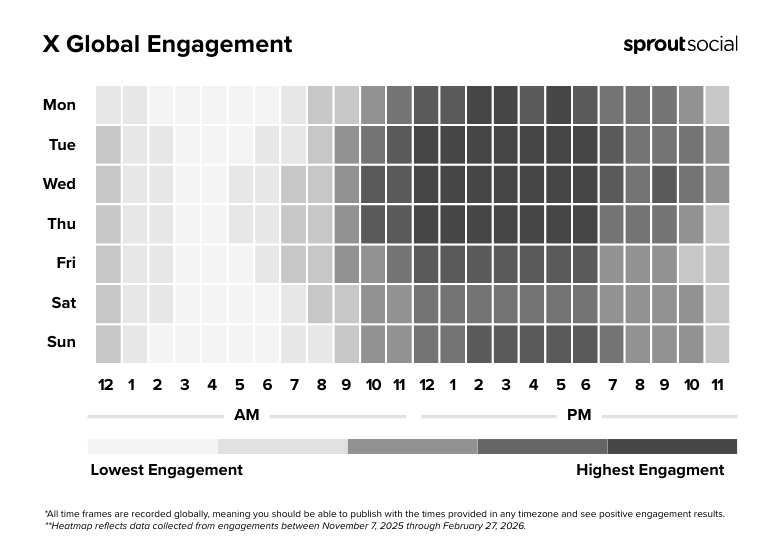
Either way, if you aren’t publishing your posts when your audience is most active, you’re inevitably stifling the reach of your content. You’re also risking an opportunity for competitors to swoop in for your followers’ precious attention.
Brands should not only be aware of when they’re posting but also how often. For example, if your competitors are consistently posting on Facebook, Instagram and X (formerly Twitter) multiple times a day and you aren’t, there’s likely a significant difference in your social followings.
Take some time to conduct a competitive audit that examines when, where and how often your competitors are posting. Doing so clues you in on ‘dead’ periods of time where nobody in your industry is posting or platforms they aren’t using effectively. This will open your eyes to opportunities your competitors are neglecting.
3. Engagement rate
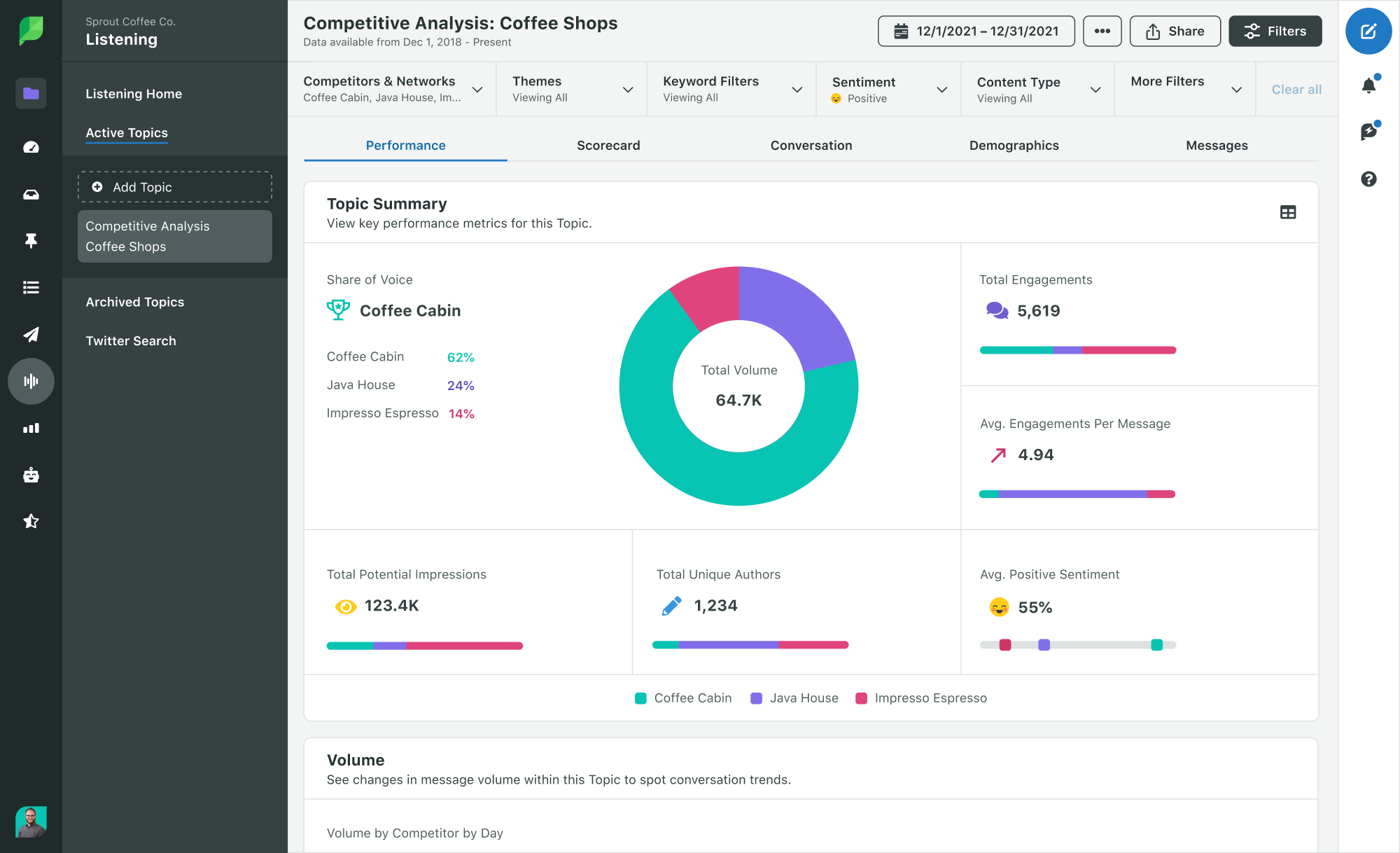
It can’t be said enough: Your follower count isn’t the be-all and end-all of your social presence. As a competitive benchmark, your brand’s engagement rate is much more important because it pits your follower count against how many likes, shares or comments a post scores.

A brand with 1,000 engaged, active followers is much more valuable than a brand with 10,000 inactive followers. Whether it’s due to fake followers or lackluster content, there are brands that have massive ‘followings’ on paper but low engagement rates.
Just like any metric mentioned here, it’s important to understand what constitutes a strong engagement rate in your specific area of business. This isn’t universal by any means and varies significantly by industry or niche.
Ultimately, higher engagement means higher participation in your campaigns. This enthusiasm is much more likely to result in sales, brand advocates and a stronger ROI for your efforts.
4. Types of content
In pursuit of more engagement, brands should look at the types of content they publish as a key competitive benchmark. Think about it. There’s so much diversity in terms of which formats perform best on which platforms.

For example, brands like RXBAR publish a combination of videos, carousels, influencer posts on their Instagram and tons of Stories, which you can see highlighted on their IG page.

The takeaway here is that competitive brands don’t just post the same type of content again and again and expect results. Similarly, you should have an idea of how your content strategy serves as a contrast to others in your space.
Your audit will reveal if they’re sleeping on video or if they don’t do much in terms of user-generated content and hashtags.
Regardless, there are so many social media ideas to ensure your content strategy doesn’t look identical to your competitors’.
5. Growth rate
Consistently publishing fresh content, rolling out new campaigns and engaging with fans will grow your presence.
And while these are all great actions to take, brands should be aware of just how much their social following grows as a result. As a competitive benchmark, growth rate examines how much your following has grown versus raw numbers which don’t mean much by themselves.
Context determines everything: 1,000 followers in six months represents explosive growth for a local business but modest progress for an enterprise brand.
Reports such as Sprout Social’s audience growth analysis track your growth rate over time alongside your competition. This helps you see if certain campaigns were more effective than others, and likewise if your competitors put together a top-tier campaign themselves.
6. Share of voice
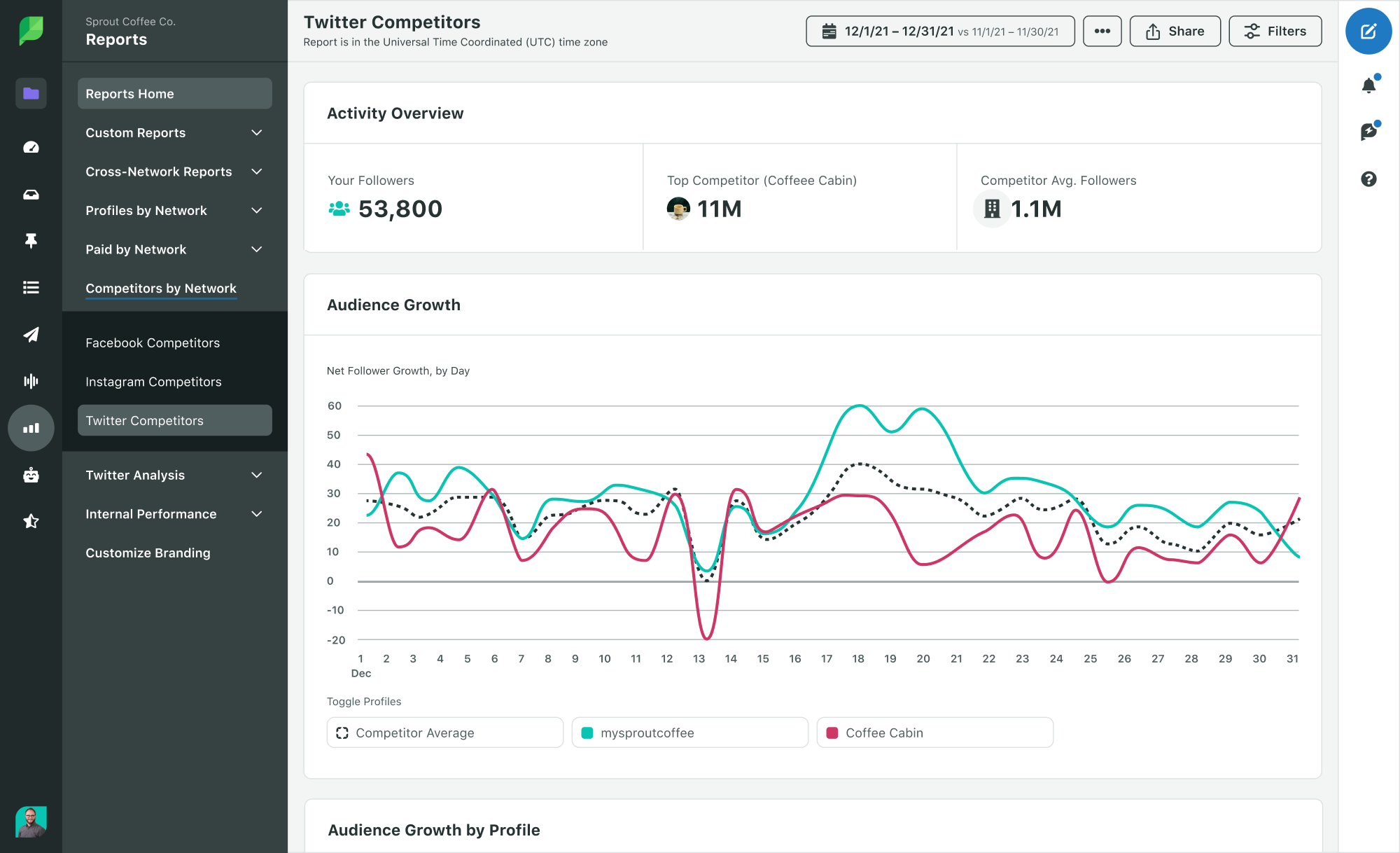
Do you consider your brand to be a leader in your industry? An up-and-comer? Somewhere in-between? No matter what space you’re in, you’re likely gunning for a position among your competition.
Increasing your share of voice ultimately involves contributing more to your industry’s conversation.
7. Sentiment analysis
There’s more to social media than just being the loudest voice in the room.
Sentiment analysis is a competitive benchmark that measures whether your brand mentions are positive, negative or neutral in the eyes of your audience.
This metric is particularly important if you’re laser-focused on customer care and engaging with your followers.

8. Social mentions
Scoring social mentions is an essential goal for any brand. Being able to participate in conversations provides moments to sell your brand in a personalized way to audiences that have already made an effort to engage with you.
As a result, you need to know who’s talking about you and who’s talking about your competitors.

Because after all, not all mentions should be treated the same. Tracking, measuring and responding to mentions in real-time also signals you as a more active participant in your industry.
How to start the competitive benchmarking process
Before we get started, we will use Sprout, amongst others, as a benchmarking tool. So if you don’t have an account, sign up for a free trial with your business email and connect your most used social media networks. Now that’s done, let’s get started with the process for a comprehensive competitive benchmarking analysis:
1. Choose competitors to analyze for benchmarking
Build a comprehensive competitor list across three categories:
- Direct competitors: Same products/services and target audience
- Indirect competitors: Different solutions to the same customer problem
- Aspirational competitors: Brands with standout social presence worth studying
You want to look at competitors whose social presence, industries, product type and target audience closely resemble yours. For example, an independent cafe or retailer operating on a smaller scale shouldn’t create benchmarks based on Starbucks or Target.
When you have this list, create a SWOT analysis to look at the Strength, Weaknesses, Opportunity and Threats between you and your competitors.
2. Choose metrics and KPIs to track for benchmarking
Quantitative social media metrics support your performance benchmarking against competitors and also identify areas of improvement for your campaigns.
While you measure click-throughs, engagement rate and ad buys from your posts, this data isn’t always readily available from your competitors. Focus on metrics that you can spot in the wild such as:
- Interactions
- Post volume
- Keywords and hashtags
It’s also helpful to ask critical questions during your analysis such as:
- Are they gaining more followers?
- How much engagement are they getting on their posts?
- How often do they post on social media? Biweekly, everyday or once in a blue moon?
- What time and days do they post? Just weekdays or weekends too?
- What hashtags do they use? Are they sticking to one or do they experiment with these?
Asking these questions and tracking the answers gives you a clearer picture of their strategy. It also unearths opportunities for your brand to stand out.
Say your competitors use trending topics and popular hashtags in their social media posts, increasing visibility and engagement. Meanwhile, your use of hashtags and trending content is less frequent or less strategic. This presents an opportunity to better align your content with the trends your audience cares about, leveraging relevant hashtags to make sure you’re part of the conversation while increasing your reach and engagement.
While you can pull all this data manually, this is where a competitive analysis tool like Sprout Social comes in handy. Our platform compiles performance metrics from competitors and synthesizes how they compare.

Beyond social media competitive benchmarks, use additional competitor analysis tools for a comprehensive view of competing campaigns. This includes:
- Email marketing frequency and campaign types
- Search traffic, volume of website visitors and target keywords
- Content publishing frequency, blog post topics and length
3. Choose qualitative data to benchmark
Qualitative research includes reviewing competitor content, reels, social carousels, stories and any other content they share.
Think about the consistent themes they have and what formats they use.
Think about any consistent themes they may have and what formats they use. Do they just highlight their product or service, or are they also featuring customer testimonials and behind-the-scenes content? Also, do they stick to static posts like carousels or are they also experimenting with Reels and stories? Additionally, consider if they are leveraging a company that helps manage social media or if they manage it in-house. This can speak to the resources they are investing and the level of professionalization they are aiming for.
This process supports the identification of opportunities you missed and the use of their content for inspiration.
Sprout Social streamlines your competitive benchmarking process by covering qualitative and quantitative metrics in one platform. A holistic overview of your competitors’ content and performance metrics supports a better understanding of how they deliver value and engage their audience.
From benchmarking to action: Competitor mapping
Competitive benchmarking provides foundational data and insights, but to take this to the next level, teams need a way to act on it. Enter competitor mapping, a strategic tool that empowers businesses to make informed decisions and seize opportunities identified in their benchmarking data.
Competitor mapping puts your benchmark data into context and helps you identify concrete next steps that align with your organizational goals. Mapping also involves using competitor data to set realistic goals and objectives and refined success metrics.
What does your competitive benchmarking strategy look like?
Competitive benchmarking is a crucial piece of any social strategy. The better you understand your benchmarks, the easier it is to come up with high-performing content and well-rounded strategies to grow your social presence.
Benchmarking is an ongoing process that you need to consistently review and adjust. Follow our suggested tactics to get a clearer picture of where you stand and what changes are necessary as you evolve your marketing strategy.
Ready to transform your social strategy with data-driven benchmarking? Download The 2025 Content Benchmarks Report and start your free Sprout Social trial to access the competitive analysis tools that industry leaders trust.





Share